EMCOGEast Michigan Council of Governments

Committees

The Full Council governs EMCOG. Its committees prepare the Council's business and carry out work it assigns. All EMCOG meetings are open to the public.

The Council and its committees

Full Council

The governing body of EMCOG, made up of representatives of its member governments. It meets in public.

  • Elects the Council officers each January, at its organizational meeting.
  • Adopts the annual work program and budget, including what members contribute.
  • Gives final approval to the Comprehensive Economic Development Strategy before it goes to the U.S. Economic Development Administration.
Who serves
Each dues-paying county is entitled to two members and two alternates. Cities, villages and townships that join in their own right are represented too.
When it meets
Usually six times a year, in January, March, May, July, September and November, at 10:00 a.m.

Executive Committee

The Council's officers. They serve together as the Executive Committee, which also acts as the Budget, Finance and Personnel Committee. The Council Chairperson chairs it.

  • Helps the Executive Director prepare the business that comes before the Full Council.
  • Reviews the budget and recommends each year how much members contribute.
  • Handles personnel matters and internal administration.
  • Chairperson

    Tim Heiden

    Sanilac County

  • 1st Vice Chairperson

    Vacant

  • 2nd Vice Chairperson

    Robert (Bob) Balzer

    Gladwin County

  • Secretary

    Mary Catherine Hannah

    Saginaw County

  • Treasurer

    Shannon Sirpilla

    City of Beaverton

Regional Economic Development Team (RED Team)

A standing committee of the Council and its Comprehensive Economic Development Strategy (CEDS) committee. The U.S. Economic Development Administration requires a committee like this of every Economic Development District, which EMCOG is.

  • Develops and updates the CEDS, the regional economic development strategy that federal economic development funding is awarded against.
  • Reviews the strategy every year and approves the annual update to the Economic Development Administration.
  • Gives member communities a forum for economic development issues they share.
Who serves
Appointed by the Council Chairperson. Members are drawn from local government, business, workforce development, education and the public, so the committee reflects the region's main economic interests.
When it meets
After each Full Council meeting, at noon.

Nominating Committee

Proposes the candidates for Council officers.

  • Presents its slate of officers at the January organizational meeting. Nominations are also taken from the floor.
Who serves
One to three members from the member communities, appointed by the Chairperson at the last Full Council meeting of the year.

Ad hoc committees

Appointed by the Chairperson to carry out a specific task for the Council, and dissolved when it is done.

Regional housing committees

EMCOG is the lead agency for the Region G Regional Housing Partnership Plan, which the Michigan State Housing Development Authority accepted alongside its Statewide Housing Plan. Three committees have worked on its goals since early 2024. Their members include local officials, real estate and housing professionals, bankers and others from the private sector.

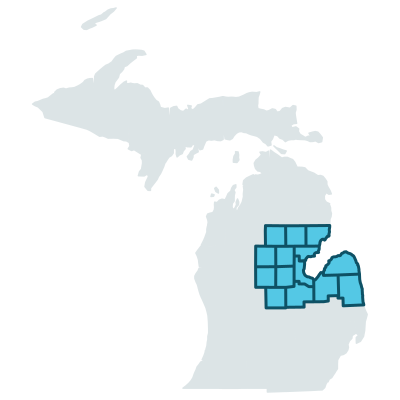
Region G covers Arenac, Bay, Clare, Gladwin, Gratiot, Isabella, Midland and Saginaw counties.

To serve on one of these committees, contact Bill Ernat at bernat@emcog.org.

Rural Task Forces

Rural Task Forces select the rural road and transit projects that receive federal transportation funding. Each county is represented equally by its road commission, its cities and villages under 5,000 people, and its rural transit provider. EMCOG manages the process for the region’s four task forces.

Task Force 7A
Huron, Sanilac, Tuscola
Task Force 7B
Bay, Gratiot, Saginaw
Task Force 7C
Clare, Gladwin, Isabella, Midland
Task Force 7D
Arenac, Iosco, Ogemaw, Roscommon

Small Urban Program

The Small Urban Program funds road and transit capital projects in urban areas of 5,000 to 49,999 people. There are six in the region.

Alma–St. Louis · Au Sable · Caro · Clare–Farwell · Houghton Lake · Mt. Pleasant